
 Back To Blog


Exclusive vs. Shared Credit Repair Leads: What’s the Difference?
 October 14, 2026
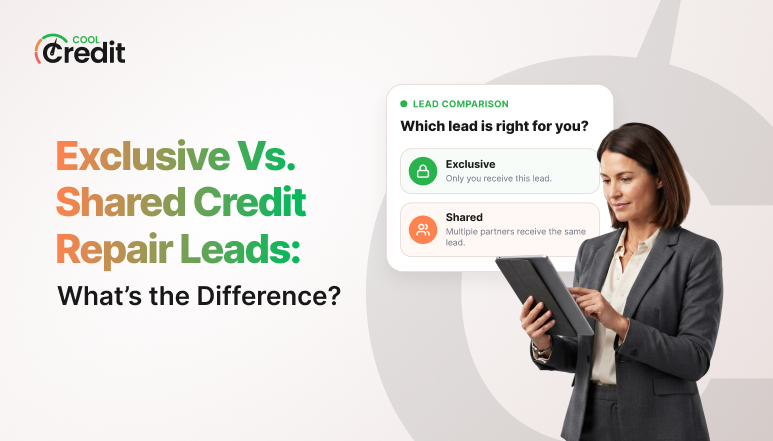
Exclusive leads are shared with one credit repair business, while shared leads are sold to multiple businesses, meaning more competition for the same potential customer.
Imagine a list of people who have actively said, “I want to fix my credit.”
They’re looking for help. They’re considering their options. They’re ready to have a conversation. Now imagine that same list being sent to five, ten, or even more credit repair companies.
Suddenly, the person who was genuinely looking for help is getting calls from multiple agencies throughout the day. And just like that, it starts feeling like spam instead of genuine help.
Tedious? For the consumer, absolutely. For the businesses trying to convert those leads? It’s just as problematic.
That’s where the difference between exclusive and shared credit repair leads becomes important. Let’s get into the details!
Ready to Grow Your Credit Repair Business?
Explore the CoolCredit Partner Network to access quality leads
Exclusive vs. Shared Credit Repair Leads: Key Differences
At the simplest level, the difference comes down to how many businesses receive the same lead.
| Differentiator | Exclusive Leads | Shared Leads |
| Lead access | Sent to one business | Sent to multiple businesses |
| Competition | Lower | Higher |
| Consumer experience | One business can start the conversation | Consumer may receive multiple calls/messages |
| Speed to contact | Important | Extremely important |
| Opportunity to build trust | More room for a personalized conversation | Often more pressure to stand out quickly |
| Cost per lead | Typically higher | Typically lower |
| Conversion potential | Often stronger when lead quality is high | Can vary significantly |
| Best suited for | Businesses prioritizing lead quality and customer experience | Businesses comfortable competing on volume |
But there’s more to the decision than simply choosing between “one business” and “many.”
Let’s look at how each type of lead actually works.
What Are Exclusive Credit Repair Leads?
An exclusive credit repair lead is a prospect whose information is provided to one credit repair business rather than being distributed among several competing companies.
The prospect has expressed interest in getting help with their credit, and your business gets the opportunity to be the one that starts the conversation.
For example:
Someone searches for credit repair help, completes a form, explains what they need, and gives permission to be contacted.
Instead of sending that person's information to ten credit repair agencies, the lead is routed to your business alone.
You can now focus on the conversation instead of worrying about whether the prospect has already spoken to six competitors.
Why businesses prefer exclusive leads
▪ Less competition
You're not immediately fighting nine other companies for the same person's attention.
▪ More room to build trust
Credit is personal. People want to feel understood before they hand over sensitive financial information or commit to a service. A less crowded conversation gives you more opportunity to establish that trust.
▪ Better control over follow-up
You can build a thoughtful follow-up process around the prospect instead of racing other companies to make the first call.
▪ A better consumer experience
The person isn't being bombarded by multiple companies simply because they asked for help once.
Of course, exclusive doesn't automatically mean qualified or guaranteed to convert. Lead quality still matters. The source, intent, consent, timing, and information collected all play a role.
What Are Shared Credit Repair Leads?
Shared credit repair leads are leads that are provided to multiple credit repair businesses.
The consumer may have requested information or expressed interest in credit repair, but their details can then be distributed among several companies competing for the same customer.
Here's a common scenario:
A consumer submits a request for credit repair help.
Five companies receive the lead.
Company A calls within five minutes.
Company B calls shortly after.
Then C, D, and E follow.
Now the consumer has five businesses offering similar services, all trying to convince them to choose their company.
From the business perspective, you have a genuine opportunity.
But you're no longer simply having a sales conversation.
You're competing for attention.
And that changes the dynamics of the entire interaction.
How Much Do Credit Repair Leads Cost?
The cost of credit repair leads depends on several factors, including how the leads are sourced, whether they're exclusive or shared, how recently the consumer expressed interest, and how thoroughly the lead has been qualified.
Shared credit repair leads generally cost less upfront because multiple businesses can purchase the same prospect. Exclusive leads tend to cost more because one business gets access to the lead without competing buyers receiving the same contact through that source.
But the price you pay per lead only tells part of the story.
What Influences the Cost of Credit Repair Leads?
1. Exclusive vs. shared access
Exclusive leads typically command a higher price because you're not competing with multiple businesses receiving the same lead. Shared leads offer a lower entry cost, but you may need to contact more prospects to acquire a customer.
2. Lead quality and intent
A consumer who has actively requested credit repair assistance can be more valuable than someone whose details come from a broad marketing list. Lead sources that capture genuine interest and clear consent can help businesses prioritize their outreach.
3. Verification and qualification
Some lead providers verify contact information, confirm consent, or collect details about the consumer's needs. These steps can affect pricing, but it's important to understand exactly what a provider means by verified or qualified before paying a premium.
4. Lead freshness
A lead generated moments ago is different from one that's been sitting in a database for weeks. When a consumer's interest is recent, your outreach is more likely to be relevant to what they're looking for. Older leads may be cheaper, but their contact details and interest should be checked.
5. Your service area and competition
Pricing can also vary based on geographic targeting, demand, the type of credit assistance offered, and the availability of leads in your market.
Are Cheaper Credit Repair Leads Always Better?
Not necessarily. The more useful question is how much it costs your business to acquire a paying customer.
Consider this example:
| Aspect | Provider A | Provider B |
| Cost per lead | $10 | $30 |
| Leads purchased | 100 | 100 |
| Total spend | $1,000 | $3,000 |
| Leads converted into customers | 5 | 15 |
| Cost per acquired customer | $200 | $200 |
Provider A offers cheaper leads, but Provider B generates more customers in this scenario. Both end up with the same customer acquisition cost.
This is why evaluating a lead source solely by its advertised price can be misleading. Track the percentage of leads you reach, how many are genuinely interested, how many become customers, and your total acquisition cost.
Also account for your team's time, follow-up expenses, refunds or replacement policies, and any other fees when comparing providers.
Exclusive vs. Shared Leads: Which Is Better?
There isn't one universal answer.
The right choice depends on your business model, budget, sales process, follow-up capabilities, and appetite for competition.
Here's how the two compare across the factors that matter most.
1. Competition
This is the most obvious difference.
With an exclusive lead, you have the opportunity to be the first and only business speaking directly with that prospect through that lead source.
With a shared lead, you know other businesses may be reaching out too.
Scenario:
A prospect needs help disputing inaccurate information on their credit report.
With an exclusive lead, you can spend the conversation understanding the situation, explaining your process, and answering their questions.
With a shared lead, the same prospect may already have two voicemails waiting and another company calling while you're on the phone.
Winner: Exclusive leads
2. Cost
Exclusive leads typically cost more because you're paying for greater access and less direct competition.
Shared leads tend to be more affordable because the cost of acquiring that lead can be distributed across multiple buyers.
That can make shared leads attractive to businesses focused heavily on volume.
But the lower upfront cost doesn't automatically mean a lower cost per customer acquired.
If you have to work ten shared leads to get the same number of customers you might get from five higher-intent exclusive leads, the economics can look very different.
Winner: It depends on your conversion economics.
3. Speed to Contact
Speed matters with any lead, but it becomes especially important with shared leads.
If several businesses have access to the same prospect, the first company to make a meaningful connection has an advantage.
That means your team needs:
- Fast lead distribution
- Immediate notifications
- Consistent follow-up
- A strong first conversation
- A process for contacting leads before interest cools
Exclusive leads give you more breathing room, but prompt follow-up still matters.
Winner: Exclusive leads offer more room, but speed matters for both.
4. Consumer Experience
This is often overlooked.
Someone looking for credit repair may already feel uncertain about their financial situation. The last thing they necessarily want is to receive a string of calls from companies they don't recognize.
A shared lead model can create that experience.
An exclusive lead model gives the business more opportunity to provide a focused, personalized interaction.
And when consumers have a better experience, businesses have a better opportunity to build trust.
Winner: Exclusive leads
5. Conversion Potential
A lead isn't valuable simply because someone filled out a form.
The real question is:
What happens after the lead arrives?
A highly motivated prospect who understands why you're contacting them, receives a relevant response, and has a good experience can be much more valuable than a cheaper lead that is being contacted by several competitors.
That doesn't mean exclusive leads guarantee conversions.
They don't.
But removing some of the immediate competition can give your sales team more opportunity to turn genuine interest into a customer relationship.
Winner: Exclusive leads, when lead quality and follow-up are strong.
Already a CoolCredit Partner?
Log in to access your partner account and manage your leads.
What Are Qualified Credit Repair Leads?
This is where the conversation gets more interesting.
Because exclusive doesn't necessarily mean qualified.
You could receive an exclusive lead that has little understanding of credit repair, isn't ready to purchase, or isn't a good fit for your service.
Likewise, a shared lead can be highly qualified.
So when evaluating a lead source, don't stop at:
“Is it exclusive?”
Ask:
- Did the consumer actively request credit help?
- Was their consent captured?
- What information did they provide?
- How recently did they express interest?
- Do they understand why a business is contacting them?
- Does their situation fit the services you offer?
- How is the lead sourced and verified?
The strongest lead strategy combines intent, qualification, consent, and fit.
What Are Verified Credit Repair Leads?
Verification adds another layer.
A verified lead is generally one where the lead source has taken steps to confirm important details about the prospect and their request.
Depending on the lead provider, this could involve confirming contact information, consent, intent, or other qualification criteria.
For a credit repair business, verification matters because your sales team shouldn't have to spend its time sorting through inaccurate, outdated, or uninterested contacts.
The goal is simple:
Spend less time wondering whether the lead is real and more time helping the person who asked for help.
Which Type of Credit Repair Lead Is Right for Your Business?
Think about it this way.
Choose shared leads if:
- You have a strong, high-volume sales operation
- Your team is comfortable competing for attention
- You have fast lead response times
- Your acquisition budget is optimized around volume
- You're confident in your ability to differentiate your service
Consider exclusive leads if:
- You prioritize lead quality over raw volume
- You want more control over the first conversation
- Your sales process relies heavily on trust
- Your team can provide personalized follow-up
- You want to reduce direct competition for each prospect
And regardless of the model, look for:
- Real intent.
- Clear consent.
- Relevant information.
- Good lead hygiene.
- A transparent lead source.
Because a lead can be exclusive and still be a bad lead.
The goal isn't simply to get fewer companies calling the same person.
The goal is to connect with the right person, at the right time, with the right context.
How CoolCredit Can Help You Explore Credit Repair Leads
This is exactly the gap the CoolCredit Partner Network is designed to address.
CoolCredit starts with consumers who are actively looking for credit and financial help.
Instead of simply handing their information to a random list of businesses, CoolCredit gives consumers a way to explore their options, consult with multiple partners, and choose who they want to work with.
For partners, that means access to people who aren't just sitting on a purchased list.
They're actively looking for help.
A network built around consumer intent
CoolCredit's network connects consumers with reviewed partners across areas such as:
- Credit repair and disputes
- Mortgage and auto lending
- Debt consolidation
- Debt settlement
- Personal loans
- Credit-building solutions
- Bankruptcy legal services
- Rent and utility payment reporting
- Other specialized financial needs
Partners are reviewed before they're listed, helping create a network where consumers can explore their options with greater confidence.
And importantly, consumers aren't forced into a single choice.
They can consult with multiple partners before choosing.
That gives them the freedom to compare answers, ask questions, and find the business that feels right for their situation.
For partners, it creates an opportunity to earn business by demonstrating expertise and building trust, rather than simply competing to be the first unfamiliar number on someone's phone.
How the CoolCredit Partner Network Works
1. Apply to join
Submit your business and service information for review.
CoolCredit evaluates partner profiles before they are listed on the network.
2. Get reviewed
The goal is to maintain a network consumers can trust.
Depending on the service category, relevant credentials and business information may be reviewed before approval.
3. Connect with consumers looking for help
Consumers exploring their options can discover and contact partners through CoolCredit.
They can compare multiple businesses instead of being pushed toward a single provider.
4. Let the consumer choose
The consumer decides which partner they want to hire.
This is important because the relationship starts with informed choice, not pressure.
5. Turn intent into business
When a consumer chooses your business, you have a prospect who has already taken meaningful steps toward getting help.
That's a very different starting point from buying a cold list and hoping someone answers.
Why Join the CoolCredit Partner Network?
Stop chasing cold lists. Start meeting people who are already looking for help.
The Partner Network is built around a simple idea:
Better consumer choice can create better opportunities for businesses.
Instead of spending your team's time calling people who may not remember requesting information, you can build relationships with consumers who have actively come to CoolCredit looking for answers.
You get the opportunity to:
- Reach consumers actively looking for credit and financial help
- Build visibility alongside other reviewed businesses
- Explain your expertise directly to prospective customers
- Let consumers compare before choosing
- Build trust before the hire
- Turn existing consumer demand into qualified opportunities
And because CoolCredit serves consumers across multiple areas of credit and financial services, partners can reach people at different stages of their financial journey.
Conclusion
The exclusive vs. shared debate ultimately comes down to one bigger question: What kind of relationship do you want to build with your leads?
A shared lead model puts you into a race for attention. An exclusive lead gives you more control over the conversation. And a consumer-choice model gives the prospect more control over who they ultimately trust.
Consumers deserve the freedom to understand their options, speak with the businesses that can actually help them, and make their own decision.
And partners deserve access to people who are genuinely looking for the services they provide.
That's what the CoolCredit Partner Network is built to do.